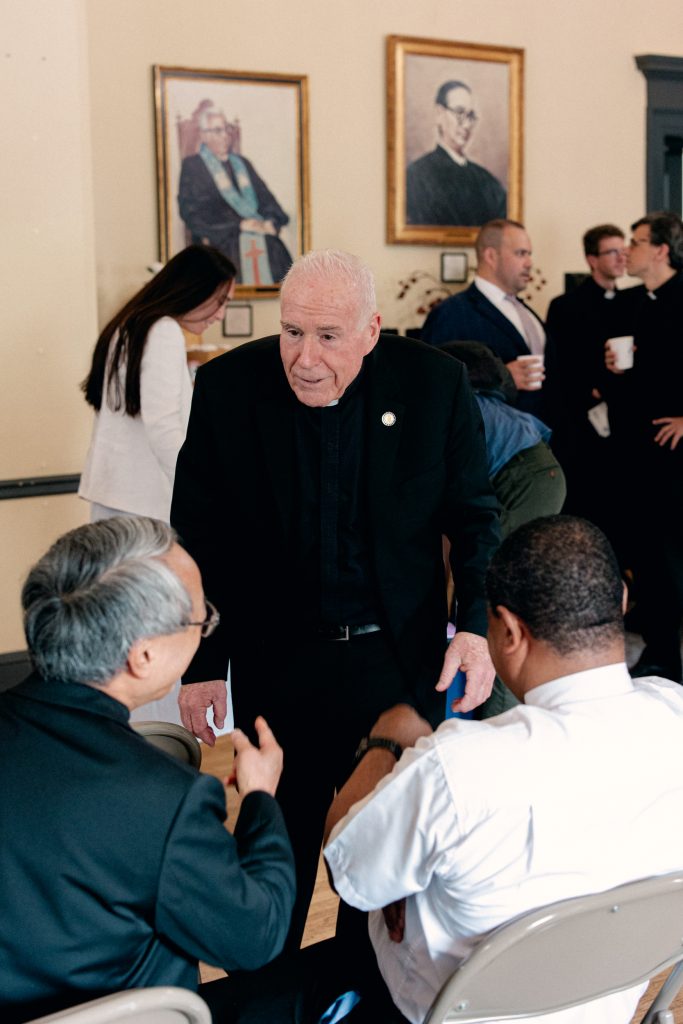
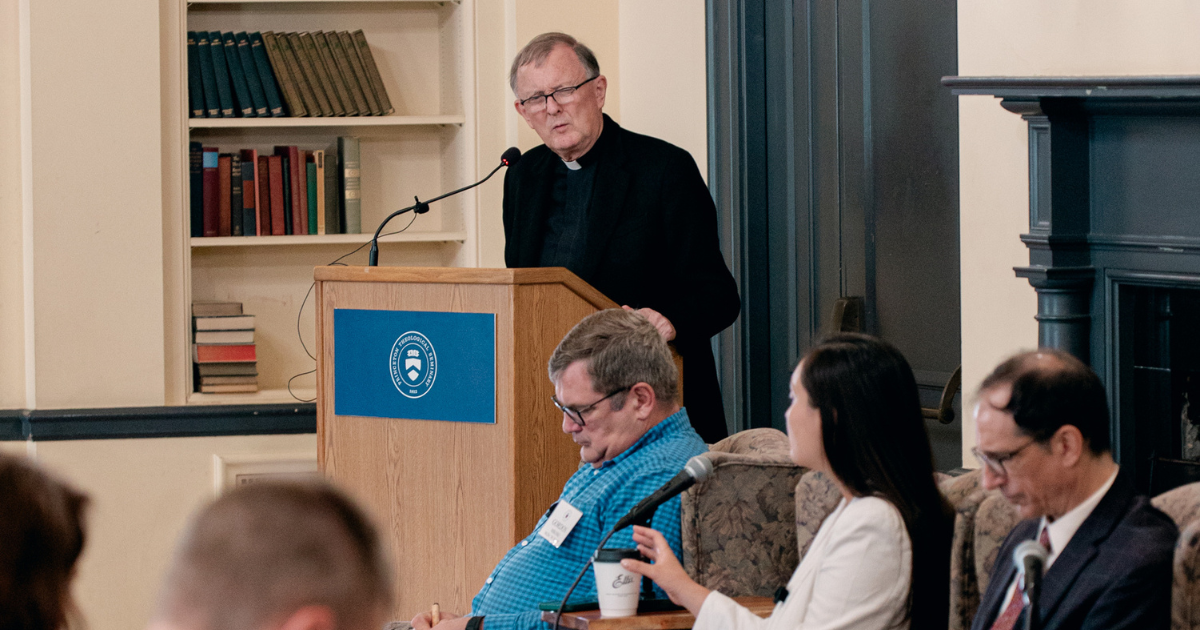
Top photo caption: Father Paul O’Callaghan, Ordinary Professor of Theological Anthropology at the Pontifical University of the Holy Ross, Rome, leads a seminar on “Christian witness amid AI concerns” at Princeton Theological Seminary. Photo by Camryn Lowe Photography
By EmmaLee Italia, Contributing Editor
Artificial Intelligence has potential for evangelization, but “there always has to be the personal element,” said Opus Dei Father Paul O’Callaghan, professor at the Pontifical University of the Holy Cross in Rome.
Father O’Callaghan emphasized the necessity of personal witness with spreading Christianity during a seminar July 17 in Princeton Theological Seminary, Princeton. A panel of prominent scholars and ethicists responded to his presentation, and audience members had an opportunity to raise questions.
The featured speaker said a person could put the phrase “Please evangelize the world” into an AI interface, and “you’d get reams and reams of paper … But are you going to convert anybody with that?”
“The tendency can be … to ‘get across information,’” he said. “But the faith is never communicated unless there are people involved … especially the truth of the faith.”
Faith is something received from God, he said – not only though grace but also through other people. And determining if something is “of God takes discernment.”
Evangelizing in an AI world
Providing the basis of Father O’Callaghan’s talk was his latest book, “Witnessing to Truth and the Dynamics of Christian Evangelization: Putting Your Life on the Line.” He explained that the book addresses the concern of “finding and understanding a proper theology for evangelization.”
“How can we evangelize today as Christians?” he asked.
“We have to ask ourselves always, ‘What’s being said? Is it true?’” he shared. “And how do you know that something is true? Because you have a witness. And a witness … is somebody who puts his or her life on the line – they sacrifice themselves.”
Truth finds its root in the very identity of Christ, Father O’Callaghan said. “He is the faithful witness because he didn’t just teach, he put his life on the line. …The Christian is the ‘witness of the witness’ … and modern man listens more to witnesses than to teachers.”
Perils of AI Reliance
Father O’Callaghan said people using Artificial Intelligence are exposed to “an enormous amount of information and ideas.”
The problem, he said, is that “sometimes it can make people a bit lazy, and they stop thinking. … There has to be a human engagement with the message and with the people around you, and you have to fight it out with them.”
One audience member raised concern over who trains the large language models like ChatGPT, sharing the experience of making several attempts to gain an unbiased perspective on the Church only to find Protestant responses.
A serious problem with relying too heavily on AI, Father O’Callaghan said, is accuracy. “I remember a few months after the election of Pope Leo XIV, if you put ‘Who is the Pope?’ into ChatGPT, the answer came back ‘Francis.’ How is it possible after six months it still says that? … You have to be very attentive to using it.”
Panelists Respond
Father O’Callaghan was joined by panelists Gordon Mikoski, associate professor of Christian education and chair of the department of practical theology in Princeton Theological Seminary; Dr. Hope Kean, post-doctoral researcher in brain and cognitive sciences in Massachusetts Institute of Technology; and Timothy Fortin, associate professor and chair of philosophical theology in Seton Hall University’s Immaculate Conception Seminary School of Theology, South Orange.
Mikoski, an ordained Presbyterian minister, said he appreciated the emphasis on personal witness, but added that while human interaction is important for evangelization, it need not be exclusive.
“I do think that the Spirit can work through Scripture,” he said. “People can read Scripture without human conversations or dialogue, and things can happen.”
Dr. Kean, who was raised in a different faith tradition and converted to Catholicism, emphasized that “AI does not have an intrinsic search for the truth, and it doesn’t have the capability to have conviction … true conversion is not necessarily just a change in spirituality [but] a move from error to truth.”
Father O’Callaghan responded to a question from the audience about AI’s strengths and weaknesses in providing information that may assist the Christian in effective witness. He noted that to be an effective witness, it is not necessary to always have more knowledge.
“When I am weak, I am strong – that’s the way Christian witness works. We’re not referring people to ourselves, but we’re linking them up to Jesus,” he said.