
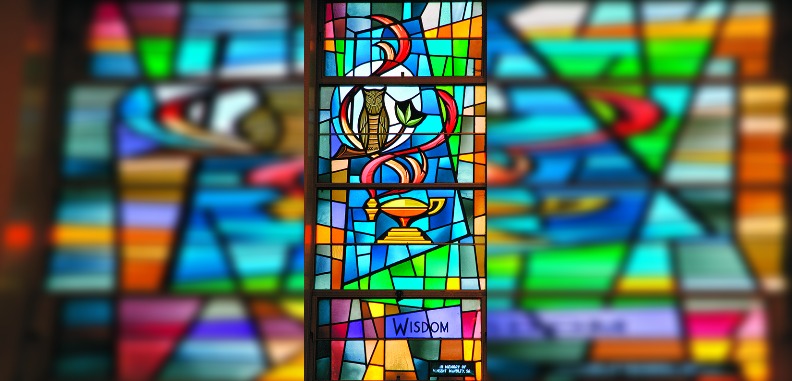
In top photo is a stained glass depiction of the Gift of Wisdom, one of the Gifts of the Holy Spirit, found in Corpus Christi Church, Willingboro.
Gospel reflection for July 26, 2026, 17th Sunday in Ordinary Time
When interviewing candidates for Confirmation, most of whom are about age 14, I ask them which Gift of the Holy Spirit they feel like they need to grow in. Most often the response is “wisdom.”
Perhaps it seems like the safe answer, but generally their reasoning generally reflects some sincere reflection. They recognize that navigating the world ahead of them is challenging and they need a grounded sense of direction as they move forward. Solomon, too, knew that he needed to grow in wisdom as he took on the responsibilities thrust upon him. When we place our trust in the Lord, seeking to grow in wisdom, we have won most of the battle.
For many of us, the idea or experience of wisdom remains illusive. We have learned from the past that wisdom comes with age and many cultures revere their elders as the sign and source of wisdom. However, that does not often match our experience. We have all seen remarkable wisdom in the young – I think now of St. Carlo Acutis who manifested a deep sense of wisdom in his short life, dying at the age of 15, while leaving a legacy of faith and devotion that brought him to be canonized at just 19 years after his death.
At the same time, we can watch the news every day and see older, often well-educated or positioned people, who demonstrate a remarkable lack of simple courtesy, compassion, and a wisdom that reflects their life experiences.
Wisdom has fascinated humans for millennia. When the Greek city states settled down and the citizenry had ample food, were generally free from tyranny, and knew a sense of peace among themselves, the luxury of reflecting on human nature and the relationship of humanity to the cosmos became a pastime for the thinkers of the time. This gave way for the great triumvirate of philosophers to emerge in quick succession, building off one another: Socrates, Plato and Aristotle. Plato’s Academy and Aristotle’s Lyceum lasted for centuries, teaching philosophy and investigating new modalities of thought on the nature of everything.
It was not just among the Greeks, however, that these questions emerged. We see similar movements among the contemporaneous Chinese and Indian thinkers as well. While they all arrived at different answers, it is the quest of understanding itself that is the very point of wisdom. The Egyptians, also, developed comprehensive forms of wisdom literature, some of which have connections to ancient Biblical texts.
Prior to this, however, Solomon, the son of David and his successor in Israel, was noted for his wisdom. So much so, that rulers and other wisdom seekers came to Jerusalem to seek his counsel and gain wisdom.
At first wisdom seems to have been confused with comprehensive knowledge. While people sought counsel from Solomon, it is also clear that he possessed strong intellectual skills.
Later, as wisdom developed and emerged as a literary form, wisdom is more understood as guides for good living and eventually to a deeper understanding of the purpose of human existence and understanding.
Jesus exemplifies Wisdom, which in the generations preceding the Incarnation, which in the Jewish tradition, had become personified. Wisdom was seen as a feminine attribute; the word for wisdom being feminine in Hebrew and Greek.
Jesus takes the understanding of wisdom to a different level. While he does not address Wisdom specifically, he associates it with prudence in pursuit of the Kingdom of Heaven. Wisdom is an expression of discipleship lived well.
First, however, one must come to know Jesus. Wisdom, St. Augustine of Hippo suggests, is the reward of faith, expressing the discovery of Christ himself. “Christ is not valued at all unless he is valued above all.” Here, in Sermon 24, St. Augustine states that the teaching of Jesus in these parables is that unless we detach ourselves from our worldly desires, of which greed, lust, and envy are the paramount expressions, we cannot truly have faith or understand Jesus and the meaning of discipleship.
We have to know how and be willing to let go so that we can achieve the higher things. But, we can find this very difficult. There are risks. The risk in selling everything to bury a field with a hidden treasure or to purchase a large and beautiful pearl is real and most people can relate to that. How many people have lost all they had in falling for a scheme that they thought would yield great benefit?
The Kingdom of Heaven is akin to that. We place our faith — all that we are and have — into a promise of eternal life and a share in the eternal Kingdom won for us by the resurrection of Jesus Christ and our participation through discipleship and the sacramental economy. That is a risk — a well calculated risk — but a risk nonetheless.
Jesus promises dividends well beyond our imagination. We just have to be willing to let go of the familiar in order to discover the extraordinary.
Father Garry Koch is pastor of St. Benedict Parish, Holmdel.