
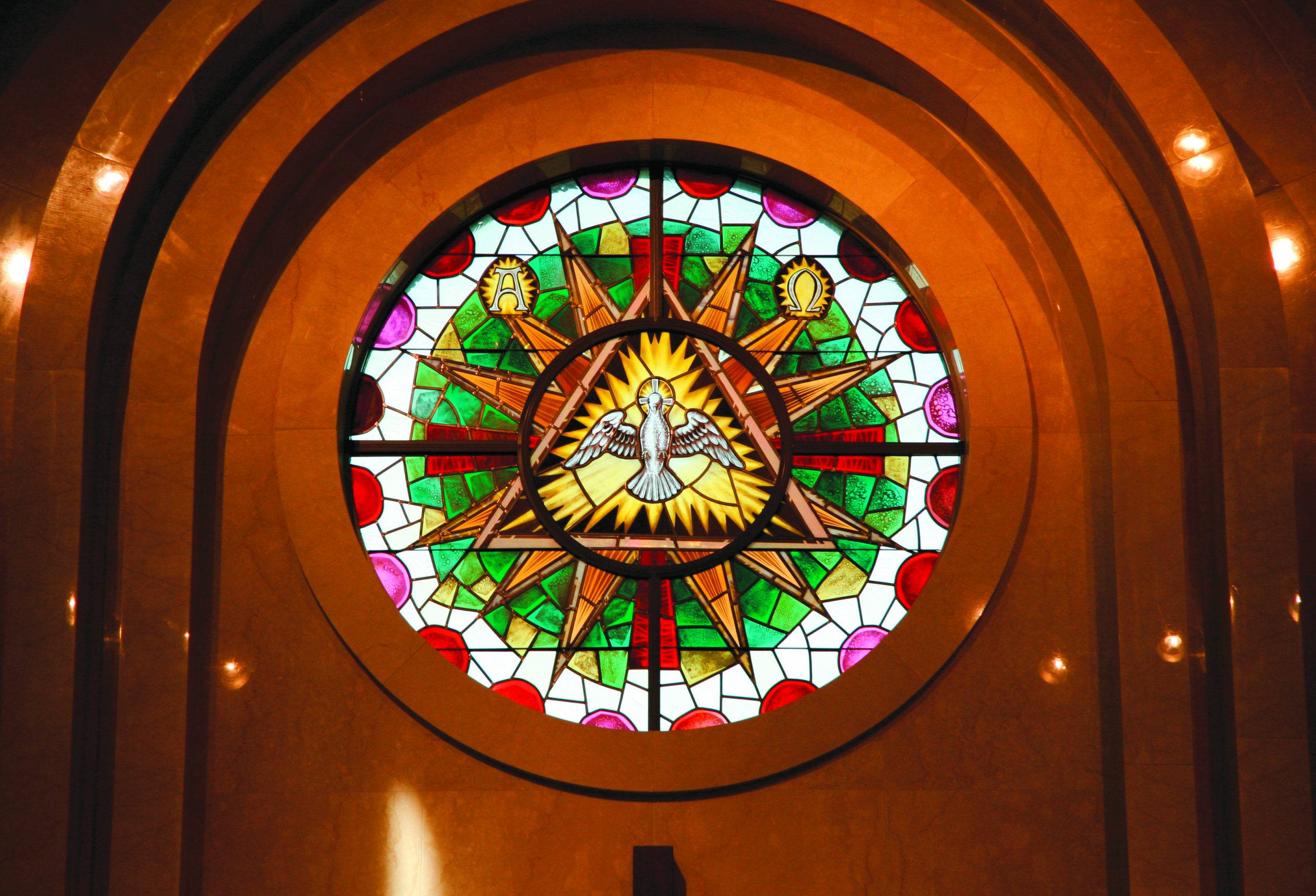
In photo above, the image of the Blessed Trinity is found above the sanctuary in St. Robert Bellarmine Co-Cathedral, Freehold. File photo
Gospel reflection for May 31, 2026, Solemnity of the Most Holy Trinity
For a variety of reasons, there has been a tendency to speak of the Trinity in terms of function instead of person. “Father, Son, and Holy Spirit” have given way to “Creator, Redeemer, Sanctifier.” This causes confusion and also serves to invalidate the Sacraments that are attempted using this terminology. We cannot limit the Trinity to function. Indeed, to do so destroys the unity of the Trinity. Pope St. Leo I stated: “When, therefore, we fix our minds on confessing the Father and the Son and the Holy Spirit, let us keep far from our thoughts the forms of things visible, the ages of beings born in time, and all material bodies and places.”
The early medieval theologian, St. Anselm of Canterbury saw the Trinity as a mystery which would be beyond the imagination of humans to develop on our own. No ancient cultic practices posted an understanding of the divine in the same way that we understand the Trinity through revelation. The Hindu conception of the Trimurti is only superficially related to the Trinity. The Trimurti is entirely different from the Trinity in terms of its own nature, its relationship to the world, and in its philosophical underpinnings.
Instead the Trinity – the unity of three Persons in one Godhead – is known to us through revelation and stands as the primary profession of the Christian faith. All conceptions of God, the nature of salvation, and call to discipleship stem from the Trinitarian understanding of God and the created order.
St. Anselm further argued, then, that theology – faith seeking understanding – is the reflection of the human intellect on this fundamental truth: God is one and yet three distinct persons.
This foundational dogma separates the Christian from the other Abrahamic traditions. Judaism and Islam while professing the Oneness of the divine, have no categories or language to understand or accept the Trinity.
There are Christians – or those who at least profess Jesus – who also struggle with this dogma.
Even among Catholics and other Trinitarian Christians, there are those who use language or imagery that is not faithful to the doctrine. While perhaps not heretical, some of these images do present a conflicting image of God.
God is One and indivisible. The Father-Son-Holy Spirit are all fully and individually God while at the same time being One.
This is where the confusion comes in. We tend to order them in rank because of our normal reaction to hold that a Father precedes a Son, and then the Holy Spirit, who is manifest later, and as we profess “proceeds from the Father and the Son” must then be less than, or at least not the same as the Father and the Son. Likewise, the non-personal term “Holy Spirit” and the representation of the Spirit as a dove, or as tongues of fire, leaves the Spirit overlooked.
The other argument that Anselm confronted, and one that we must be careful not to fall into, is that the Trinity is merely how we understand the divine, as God is so beyond our imaginings that we cannot comprehend God in himself. So, the argument goes, we speak of God as a trinity to help us relate to God, but God is One. This leaves us with a quandary of deception. God would not reveal something to us which is not true. The mystery of the Trinity, revealed in and through the Incarnation of the Son and the descent of the Holy Spirit, is nonetheless foreshadowed in the ancient Hebrew Scriptures, beginning with the very opening lines of Genesis. The Trinity is ever present. It is only in light of the Incarnation that the fullness of this revelation is made known to us.
As Christians, the Oneness of God and the Dogma of the Trinity are essential in our understanding of God and our relationship with him.
We pray to the Father, through the intercession of the Son, at the prompting of the Holy Spirit.
The Spirit guides and directs the church, effects the Sacraments, and calls us into our relationship with the Son.
Our Catholic faith calls us to live in the paradox of the Trinity, understanding that God is made known to us so that we might all be kept safe on the journey to eternal life, and know the guidance of God – Father-Son-Holy Spirit, in every aspect of our lives.
Father Garry Koch is pastor of St. Benedict Parish, Holmdel.