
Shroud image shows ‘core of our salvation,’ says educator
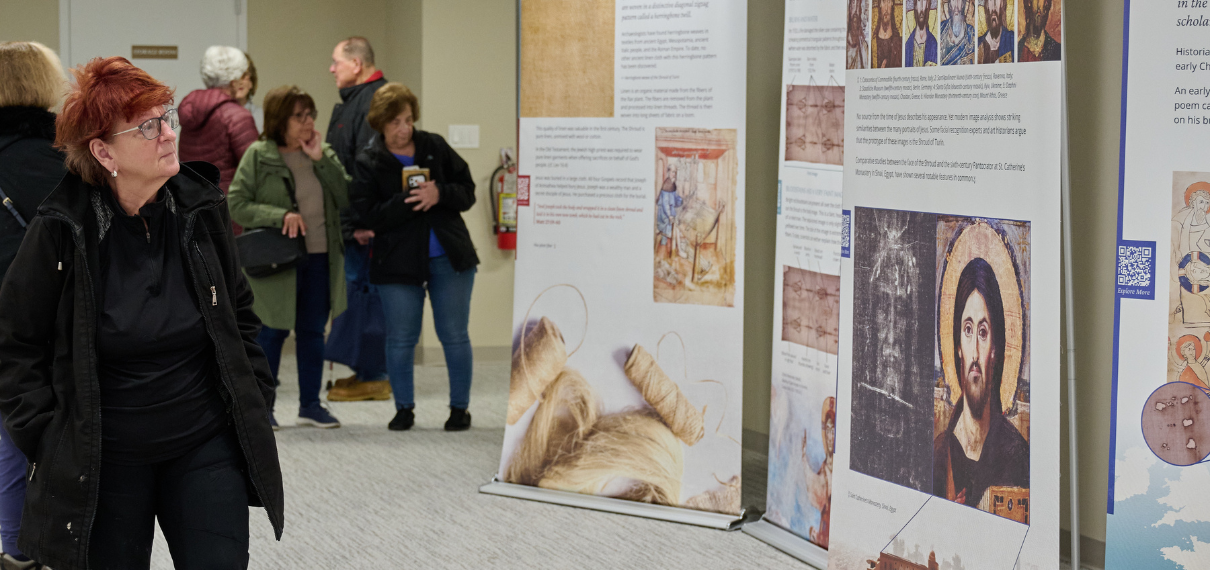
Top photo caption: Shroud exhibit attendees pause to read details comparing the cloth’s image to early paintings depicting Christ. Mike Ehrmann photo
By EmmaLee Italia, Contributing Editor
The Shroud of Turin shows Jesus’ love and “all that he suffered in that crucifixion … that he was true God through man, and that that crucifixion was not the end of it,” Shroud educator Pam McCue said in a series of talks in Hamilton parishes March 23-25.
“I think this image left for us shows us the core of our salvation,” she said.
During her presentations, McCue – a representative for Othonia, a Shroud education organization – gave audiences a point-by-point description of what the Shroud reveals, and addressed theories and controversies in her presentation, “Who Is the Man in the Shroud?”
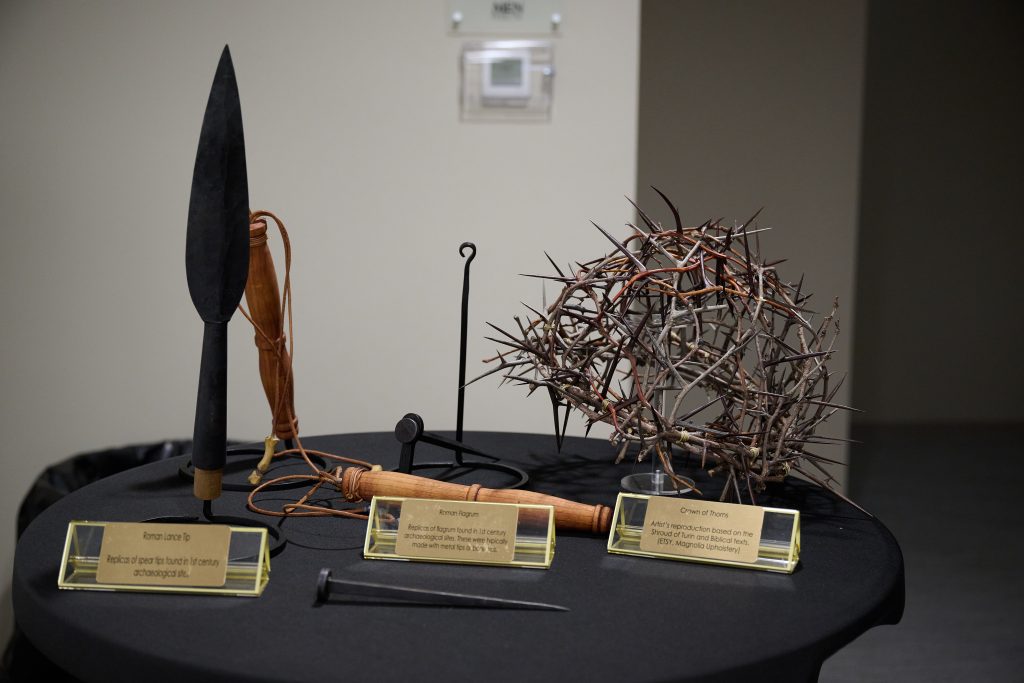
An accompanying display of panels, Shroud replicas and 3D statues of the image were available for viewing in St. Gregory the Great Parish, Hamilton Square, March 20-26. Organizers said people from more than 70 parishes registered to attend.
Uncovered through Science
Believed for centuries to be the burial cloth of Jesus mentioned in Scripture, the Shroud has been the topic of debate and scientific inquiry ever since the first photograph of the cloth revealed the negative image. On May 28, 1898, Italian amateur photographer Secondo Pia captured the image when the Shroud was on public exhibition in the Turin cathedral; the negative revealed details of the face and body that had not been visible.
“The image is so superficial that you can take a razor blade and scrape it off the cloth,” McCue told those in attendance March 25 at St. Raphael-Holy Angels Church, Hamilton. She said the Greek word “acheiropoieta,” meaning “not made by human hands,” best describes the image on the Shroud.
“Much of the scientific study … comes from people recognizing how very different [the Shroud] is and how fascinating it is,” she said. “Many people respected the cloth as the burial cloth as Jesus, but when the scientific community got involved, it really took off – and people who were not religious, who were atheist or agnostic or neutral, began to study it.”
Using modern tools of discovery, including ultraviolet light, details consistent with Jesus’s Passion and Death are revealed by the image: water stains, AB blood type consistent with Eucharistic miracles, wound marks in the feet and wrists, more than 370 scourge wounds, a swollen face with broken nose, head wounds from a cap of thorns, and shoulder abrasions from carrying a heavy crossbeam.
“The body was still in rigor mortis when the image was made,” McCue said, adding that rigor mortis lasts about 40 hours.
Although the 1998 study reported that carbon-14 tests dated the cloth between 1260 and 1390, in the last seven years “those tests have been shown to be invalid,” McCue said. “They’ve shown to be really the worst of science; they misrepresented the test, they hid data, and they reported with high confidence when they knew they had inconclusive results.”
Origin and Energy
The Shroud material speaks to a first-century origin, McCue said, because of the way the flax fibers were woven at that time.
Pollen particles found on the Shroud “come from 58 varieties of plants – 35 from Jerusalem, with 13 unique to that area. The rest are from Asia Minor and Europe, along the path the Shroud traveled,” she said.
Dirt particles are present on the Shroud on the areas of the feet, knees and broken nose, hinting at a man falling on his face. The dirt – travertine aragonite limestone – has a specific chemical composition that “matches Jerusalem like a fingerprint,” she said.
Early paintings depicting Jesus, particularly one from St. Catherine Monastery on Mount Sinai in 550, seem to mirror the Shroud image, with facial recognition experts finding 150 points of congruence.
The prevailing theory is that some kind of radiation or energy produced the image, McCue said.
“Radiation is a natural phenomenon – I think that’s one of the gifts of the Shroud, that so much of this science pulls us along with it. Radiation microwaves, cooks our food, the sun burns our skin, X-rays go through our body. But in this case, what provided the energy was the body of Jesus.”
Time for Reflection
During a question-and-answer period, audience members asked about the veracity of other cloths such as the sudarium, the cloth used to wrap Jesus’ head, the apparent lack of myrrh on the Shroud, and future tests that might help in dating the Shroud. McCue noted that the blood on the Sudarium of Oviedo, Spain, matches the AB blood type found on the Shroud.
“The current thought is that the myrrh and aloe that Nicodemus brought could have been in powder form instead of oil,” McCue said. “One theory about why you don’t see any image on the sides of the cloth is that the myrrh and aloe, if packaged in something solid, could have lined the bottom or sides.”
Carbon-14 testing, she noted, is destructive, and can even be produced by the amount of energy needed to make the image on the cloth. “If you start chasing carbon-14, you can make Swiss cheese of the burial cloth and still not get satisfactory answers.” But if a less destructive carbon-14 method becomes available, it’s possible scientists could test it again.
Santa Trombino, a parishioner at St. Raphael-Holy Angels, said: “The 370 wounds on his back and thighs … makes me think how unworthy I am, that he did that for me – and yet, I still sin. It’s overwhelming.”
“It’s a presentation of love,” said fellow parishioner Josephine Woodward. “It’s this brutality, but all throughout it was that unconditional, perfect love, and it’s just celebrated throughout that Shroud exhibit … it’s the awe and wonder – and it boils down to faith.”
Students share impressions of Shroud exhibit
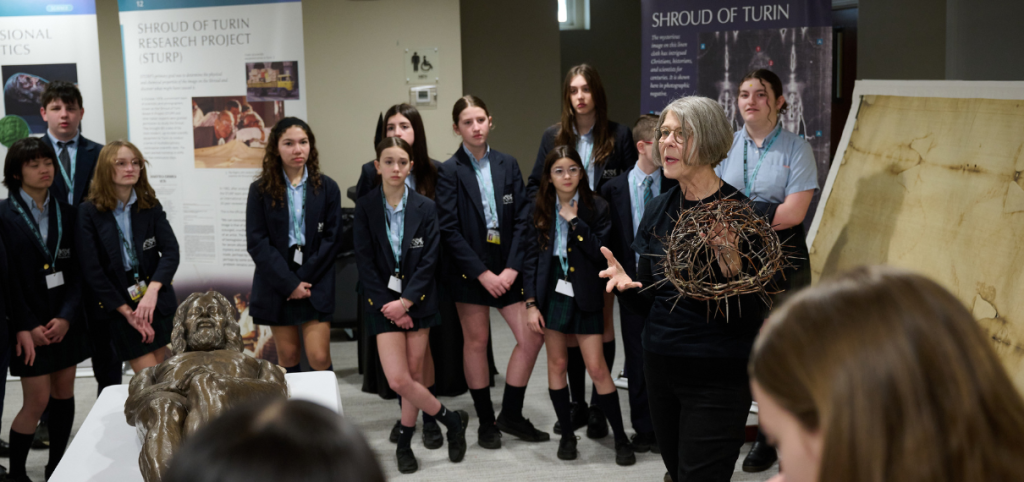
For St. Gregory the Great Academy students, attending the Shroud exhibit was transformative.
Seventh-grader Thomas Biele, who saw the exhibit with classmates, remembers his grandfather’s photos from Jerusalem many years ago when he walked the Way of the Cross.
“Those pictures and this exhibit [have] changed the way I think about the Stations of the Cross and the Passion of our Lord,” Biele said.
Details he learned from the exhibit included how Jesus might have carried the cross, and what happened to him during that walk.
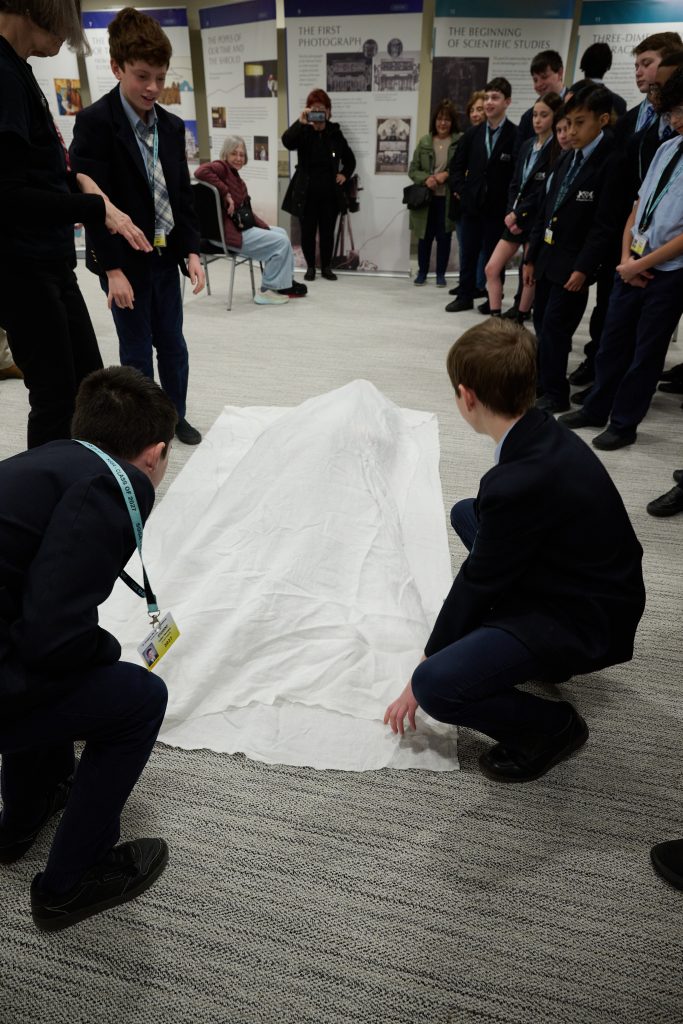
“[On] the Shroud of Turin, the cartilage of Jesus’ nose was broken … His arms had to be twisted around the crossbar,” Biele reflected. “Jesus lost 20% of his blood on the way to Golgotha. That amount of blood lost sends the human body into shock, not surviving much longer. Jesus, even with all that blood lost, continued up the hill until he reached his final place.”
Fellow seventh-grader Gianni Trembicki said the Shroud of Turin “has really made me reflect about what happened to Jesus, and the sacrifices he made for all of us.”
The presentation, Trembicki noted, “really helped me understand everything that Jesus went through in those final moments. I found that the replica of Jesus really made me think about my connection to Jesus and how he suffered for us.”
Some new details he observed from the exhibit included the cap-shaped crown of thorns, the evident torture marks on the Shroud, and additional information revealed by X-ray. Trembicki eagerly shared all he learned with his family later that evening.
“While it was a painful suffering time for Our Lord, it really focuses on what he did for us and how he forgave all of these people that hurt him,” he reflect-ed. “This exhibit was truly touching. Learning about this has made me grow closer to Jesus, and I will be forever grateful for the life he has given me.”