
By Nicholas Diat, OSV News
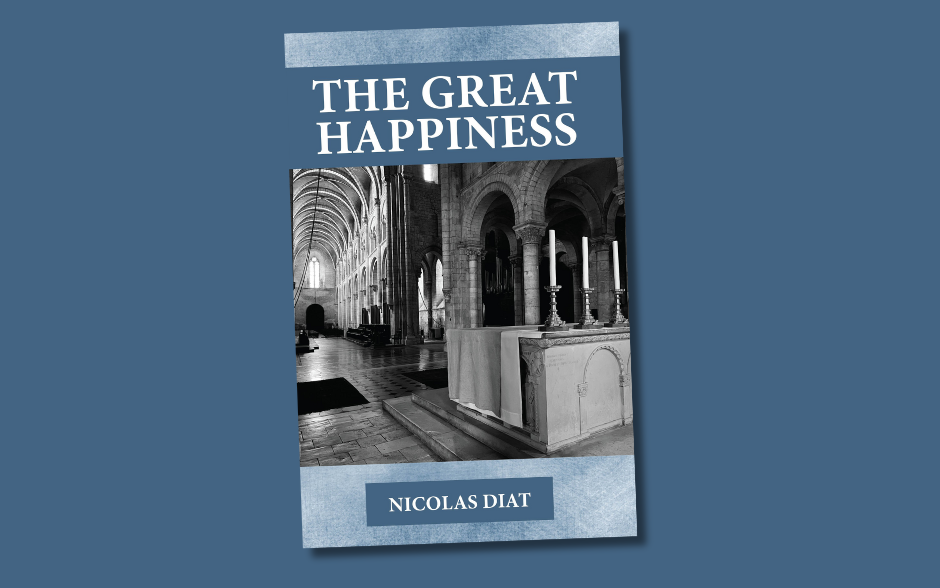
An excerpt from “The Great Happiness” by Nicolas Diat (OSV, $26.95).
A monk never forgets the day he understood that God was calling him. The morning of entering the cloister, the ceremony of perpetual profession or the ordination Mass remain etched in his memory. But the day of recognition, the day of certainty of the call, is unique.
Father Ambroise remembers it very well. Coming from an aristocratic family, he entered the abbey at the age of thirty-one. Several of his uncles were priests; two were Assumptionists. A bright student, he attended the Prytanée Militaire de La Flèche. He discovered Fontgombault during a retreat. The young man was struck by the phrase written on the dusty sign at the back of the church: “The monks come seven times a day to give God the worship that is due to him.”
We met on a rainy morning in a charming room in the guesthouse. Robust, with a youthful face, slightly flushed, he spoke to me about his previous work in real estate inspection. He lived in a house in the countryside with his hunting dog. A happy bachelor. His desire for independence was stronger than anything else. This son of a good family did not want to be enlisted. He wanted to be free.
In short, he was far from thinking about the vocation. During the summer of 2008, he went to the monastery for a three-day retreat. The result was not very positive. For six months, he lost sleep. How could he talk about his torment that never left him? He returned to Fontgombault for another week of retreat and asked to meet a monk. The prior, Dom Pateau at that time, came to see him in his cell. But he declared himself unable to answer his questions. Dom Pateau promised to pray for him and sent him to the novice master.
In the morning, he wanted to become a monk. In the afternoon, he had doubts. In the evening, he knew nothing. Yet, deep down, he thought he was meant for Fontgombault. Then, at a specific moment, with lightning-like clarity, an unimaginable precision, he knew that he had to respond to God’s call, feeling in a physical way that his religious vocation was irreversible.
It is difficult to enter the monastery at the age of thirty. For a year, once a month, Father Ambroise took the road to Berry. He sought to maintain contact, to keep the flame alive. He continued to keep his secret. His parents, brothers, and sisters knew nothing. One Sunday evening, in the kitchen of the family home, he decided to take the plunge and announce the big news. After the initial vertigo, like a leap into the void, his family accepted his choice. He had to quit his job. A colleague had this striking phrase: “I won’t be able to say that it’s good news, but it’s big news.”
How can one part with one’s belongings at an age that is no longer that of prime youth? “It’s sometimes crucifying!” The gift of his signet ring, to which he was attached, was not an easy gesture. A year later, learning that his father had modified the stock of his rifle to put it “to bed” saddened him. Monks, after all, are men.
The move did not happen without some tension, a touch of nervousness. He was torn away and released on the same day. “There is so much to unlearn,” he confided discreetly — that is, the love of freedom, a form of selfishness, too.
When he came to Fontgombault, he was impressed by the monks’ smiles. It was a deep and refreshing smile. This brightness reassured him about the reality of their happiness. He hoped for the same joy for himself. The serenity of the monks was a rock, an island to reach: “If they are joyful, then I can become joyful, too.”
For Father Ambroise, the secret of the spiritual life is solely to love. The relationship with God is simple. The monk is a child who plays, and children who play are never alone. Either they play together, or they invent companions. The external world no longer exists for them.
What is the secret of this game? What is the rule? Nothing extraordinary: “The Lord is behind the door. He does not force. He waits for us to open it. He wants us to come spontaneously to him.”
The day he entered Fontgombault, as his family left by car, no one spoke during the journey. His dear mother later told him: “We would have felt like we were breaking away from such a profound moment.”