
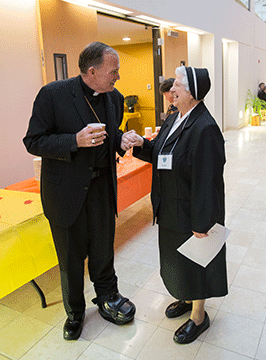
In observance of the Year of Consecrated Life, The Monitor will dedicate a monthly feature, sharing stories of different individuals in our Diocese who have committed their lives to serving God as a religious priest, brother or sister. In the first of these monthly insertions, Bishop David M. O’Connell, C.M., tells the story of his choice to become a member of the Congregation of the Mission of St. Vincent de Paul.
Inspired by word and witness
First in a Series
I am a Vincentian priest, a member of the Congregation of the Mission of St. Vincent de Paul (CM). I have spent all of my adult life in that community. My journey into consecrated life was a process that began in grammar school when I began reading about St. Vincent and the congregation he founded in 1625. I had always wanted to be a priest as long as I can remember. There were no other priests or religious in my family to give an example of, or to talk to about, what it meant to serve God and his Church this way. I went to Catholic school in the Archdiocese of Philadelphia where the Sister Servants of the Immaculate Mary (IHM) taught. It was these great women religious who inspired me by word and witness. I was an altar boy and close to the diocesan priests serving in my home parish. It was these great men, especially my pastor, who inspired me by word and witness. These sisters and these priests first put the idea of a vocation in my head, more by what they did and the way they did it than by any words they spoke.
In the 1950s and 60s, the Catholic Church, parish and parish school played hugely important roles in Catholic life. They were the places where everything happened: Mass, benediction, baptisms, weddings and funerals; studies, dances and sports; volunteering, charity, socials and, yes, bingo! Every year, the Serra Club sponsored a “Vocation Day” in my parish school when women and men representatives from every religious order imaginable came together in the gym to try to interest young and impressionable girls and boys in religious life. Dressed in habits that distinguished them from one another, these sisters, brothers and priests distributed posters and pamphlets and talked eagerly with us about their lives and ministries. I can remember riding the school bus home with my schoolmates, chattering away about becoming a sister or a priest and going off to some exotic missionary land.
Of course, these memories are from days gone by. But they are as fresh in my mind’s eye as though they happened yesterday. They were good days. They made us think about vocations and introduced us to possibilities for our lives. It was during such an exhibit that I first heard about the Vincentians and first met a Vincentian priest. Something stuck. Something impressed me about St. Vincent de Paul’s work with the poor on the streets of Paris and throughout France. Something made me imagine myself doing his work with priests like the one I met. The Vincentians didn’t wear special habits; they dressed like my parish priests. They were not very well known in the United States; I had never actually heard of them before although their local Mother House was in Philadelphia. But the idea of being a missionary and traveling the world rather than serving in one diocese intrigued me – enough to write for more information, enough to make me want to visit their seminary, enough to make me join them as a young man. And the rest is history.
The Vincentians are not a religious order like the Franciscans or the Jesuits. They are a “Society of Apostolic Life:” priests and brothers with simple vows of poverty, chastity and obedience who live together in community and work as missionaries, teachers and preachers; prison, hospital and college chaplains; and parish priests in dioceses all over the United States and the world. It’s funny, but my childhood dreams of joining the Congregation of the Mission and becoming a missionary never materialized. God had other plans. But through every assignment I have ever had, including my present one as a diocesan bishop, I have never lost or given up my desire to follow St. Vincent de Paul and his confreres; to be conscious of the poor and the needy; to love and serve priests; and to preach the Gospel at every turn in the bend of life. Being a Vincentian does influence the way I live and minister as a bishop. I am happy to celebrate this “Year of Consecrated Life (2014-15)” as a diocesan bishop with the letters “CM” after my name. They are a daily reminder of where my journey began and how I should live out my priesthood. I pray that other young men will pursue becoming priests, in consecrated life, in the Vincentians and in the Diocese of Trenton. “Why not you? Why not now?”