
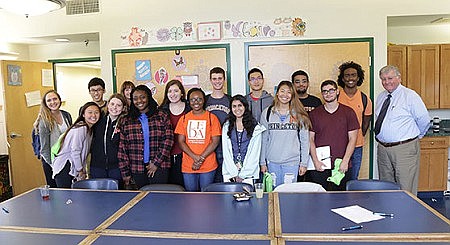
At a time when many college freshmen would be preoccupied with moving into their dorm rooms, several hundred members of Princeton University’s entering class spent a recent week off campus learning about community service organizations in the Diocese of Trenton.
Staff from Catholic Charities Diocese of Trenton and the New Jersey Catholic Conference was invited to meet with the students as part of their exploration of faith-based communities and organizations in Trenton. The gathering was part of Community Action, a weeklong immersion orientation program for Princeton University first-year students coordinated by the school’s Pace Center for Civic Engagement.
“The goal is to introduce students to faith-based and interfaith work and help them develop a better understanding of the network of religious institutions and spiritually motivated individuals that form and support the Trenton-area community,” said Emma Coley, Community Action fellow at the center.
One group of 14 students met with Susan Loughery, director of operations at Catholic Charities, Diocese of Trenton, and Cheryl Davis, clinical director of Catholic Charities’ Mercer Behavioral Health Services.
They also met with Patrick Brannigan, NJCC executive director, and James King, NJCC director of social concerns.
Davis provided the group with a tour of the behavioral health services facility operated by Catholic Charities on Southard Street in Trenton, explaining that nearly all of an individual’s needs are met under one roof. The building includes a wellness center, a pharmacy, a primary care exam room, a cafeteria and many group and individual counseling offices.
Davis stressed that “mental illness and addiction do not discriminate; no one is immune to these illnesses and nearly one in four adults will be affected at some point during their lifetime.”
In addressing students’ questions regarding the role of the Catholic Church on social issues,
Brannigan said the Church’s approach is neither conservative nor liberal.
“We walk with those least advantaged among us and serve as advocates for those in need –the immigrant, the sick, the marginalized.”
“We believe that all people are made in the image of God. So, if we are made in the image of God, what image of God should people see when they look at us? For me, the answer is love because God is love. People should find God’s love in how we live.”