
The following news briefs were recently published by Catholic News Service:
New Orleans ‘Hope Monstrance’ to visit U.S. communities hit by disasters
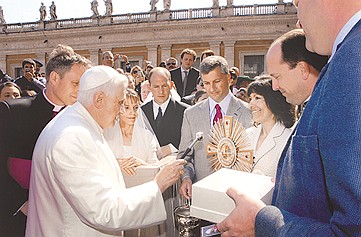
NEW ORLEANS — When the levees broke in 2005 and Lakeview became Lake Pontchartrain, three weeks of brackish and corrosive water, chemicals and mud had all but destroyed a gold-plated, eucharistic monstrance housed in a small chapel at St. Dominic Parish’s Aquinas Hall. The monstrance laid on its side and entombed in the muck at the foot of the altar. Before the storm, parishioner Susie Veters removed the Blessed Sacrament from the monstrance and placed it in the tabernacle. The empty monstrance remained on the chapel altar behind locked the doors. Eight feet of lake water lifted it off the altar and dropped it to the floor, burying it in mud. It was lovingly restored by a parish choir member. On March 15, 2006, Veters, her husband and a new Orleans priest were in St. Peter?s Square where Pope Benedict XVI blessed the vessel and granted a plenary indulgence to those who prayed before it and fulfilled other necessary conditions. The “Hope Monstrance” traveled in 2006 and 2007 to 140 churches across Louisiana and Mississippi amid the recovery from Katrina. Now it will travel to Houston, Las Vegas and Santa Rosa, California, recovering from 2017 tragedies — hurricane, the largest mass shooting In U.S. history and wildfires, respectively.
U.S. attorney general’s new legal directive may speed up deportations
WASHINGTON — U.S. Attorney General Jeff Sessions issued a decision Sept. 18 curtailing the powers of U.S. immigration judges in deportation proceedings, a move that may make it easier for the Trump administration to deport migrants. The news agency Reuters reported Sept. 19 that Sessions set limits on the ability of judges to terminate deportation cases and said the judges “have no inherent authority to terminate removal proceedings even though a particular case may pose sympathetic circumstances.” If a judge terminates or dismisses a case, in some circumstances, the move may buy some time for the person under deportation proceedings to pursue a different way to remain in the country. Some worry that the new directive paves the way for speedier and more abundant deportations, perhaps signaling upcoming aggressive moves by the Trump administration on the immigration front. In mid-September, in discussing with Hill.TV how a monument in Pennsylvania marking where one of the planes involved in the 9/11 attacks went down inspired him, President Donald Trump spoke of the “gorgeous wall where the plane went down in Pennsylvania, Shanksville,” hinting also at the border wall he wants to build between the U.S. and Mexico. The 9/11 memorial has a series of walls.
New partnership to help families reunite using donated airline miles
ALEXANDRIA, Va. — Catholic Charities USA and Miles4Migrants have formed a new partnership to help members of immigrant and refugee families who have been separated be able to reunite. Through donated airline miles, the two organizations will work with local Catholic Charities agencies to identify those who need assistance with purchasing airfare to reunite with their families, said a Sept. 20 announcement on the partnership. “At the heart of the work of Catholic Charities is caring for the most vulnerable among us,” said Dominican Sister Donna Markham, president and CEO of Catholic Charities USA. Based in Alexandria, the national office represents 166 diocesan Catholic Charities agencies. “It is in that spirit that we support our agencies’ efforts to assist immigrants and refugees who arrive in this country,” she said in a statement. “We are excited for the increased opportunity this partnership provides to reunite families separated at our borders.” Miles4Migrants is a volunteer-driven, nonprofit charity that uses donated frequent flyer miles and money for the relocation of refugees and those seeking asylum “to start a new beginning in a new home,” said the announcement.
Pope: Those exploiting foreigners for profit will pay on Judgment Day
VATICAN CITY — No one can remain indifferent to the way minority groups are increasingly the object of so much fear, scorn and hatred, Pope Francis said. And he warned those who profit from exploiting foreigners or people in precarious situations and those who contribute to today’s new forms of slavery that one day they will have to answer to God for the choices they have made, he said Sept. 20. The Pope’s remarks came in a written speech he handed participants attending a Sept. 18-20 conference on “Xenophobia, Racism and Populist Nationalism in the Context of Global Migration.” The gathering was jointly hosted by the Dicastery for Promoting Integral Human Development and the Geneva-based World Council of Churches in collaboration with the Pontifical Council for Promoting Christian Unity. In his speech, the Pope noted how “feelings of suspicion, fear, contempt and even hatred” were on the rise against individuals or groups who have been judged to be “different” based on their ethnicity, national origin or religious affiliation, and, as such were being considered “not sufficiently worthy of being fully part” of a community’s life. These feelings, he added, “all too often inspire real acts of intolerance, discrimination or exclusion” and can gravely harm people’s dignity and rights.
Christian aid group says Idlib civilians fear offensive by Syrian forces
AMMAN, Jordan — Christians and other civilians inside Idlib, Syria, are fearful of an impending, all-out offensive by their government and its Russian and Iranian backers on the northwestern province, the last rebel stronghold and presumed endgame in Syria’s more than seven-year-old war. “A Franciscan father told us that the situation in Idlib is really bad, the people are very scared. They don’t know what will happen and it’s unclear what is actually taking place,” Andrea Avveduto, communications chief for Pro Terra Sancta, told Catholic News Service Sept. 17. The association, based in Jerusalem and Milan, supports the Franciscan Custody of the Holy Land. Russia and Turkey agreed Sept. 17 to create a demilitarized buffer zone in Idlib province to separate government forces from rebel fighters based there. It is unclear whether the zone, expected to come into force by Oct. 15, would help avert an all-out assault on the rebel-held area, as Syrian President Bashar Assad has vowed to regain the region. Pope Francis, U.S. President Donald Trump and the United Nations have all warned of a “humanitarian catastrophe” unfolding should Syria, Russia and Iran go forward with an attack on Idlib. Jan Egeland, who heads the U.N.’s humanitarian task force for Syria, has liken the anticipated assault to conducting a “war in a refugee camp.”
Virgin Islands diocese still recovering from 2017 double hurricanes
PORT-OF-SPAIN, Trinidad — One year after Hurricanes Irma and Maria smashed through the Virgin Islands, people remain jittery about the rest of the 2018 hurricane season. “Everyone is extremely nervous and anxious about going through another hurricane without recovering from the previous two,” said Warren Bush, chief financial officer for the Diocese of St Thomas. A combination of heavy bureaucracy, sometimes sluggish supply chains and a shortage of contractors have slowed recovery efforts, leaving repairs to many damaged homes and public buildings still incomplete. Now, at the height of the current hurricane season, “We have to stabilize buildings to prevent additional water damage,” Bush said. “We’re very concerned about what could be.” On Sept. 6, 2017, Hurricane Irma mowed through the islands and, two weeks later, Hurricane Maria devastated whatever was left. Both hit as Category 5 storms. “We’ve never experienced this level of destruction,” said Bush. “And on the three islands, all at once.”
Crimes against Christians may not always be religiously motivated, say experts
ROME — Social media has helped spread “fake news” alleging criminal or violent attacks against Christians in Pakistan as examples of hate crimes and religious extremism, reported ucanews.com. In reality, in some recent cases, the incidents turned out to be motivated by personal grievances or a desire for revenge — not hatred against Christians or minorities — meaning religious intolerance in this Muslim-majority nation “might not be as pervasive as is thought,” the news agency said. For example, in August, an 18-year-old Christian woman, Binish Paul, was seriously injured after being thrown from the roof of a two-story building by Taheer Abbas, a Muslim police officer who had been harassing her to marry him. Tabassum Yousaf, a Catholic lawyer, told the Catholic charity Aid to the Church in Need Sept. 17 that “for months, Taheer had been putting pressure on Binish to convert to Islam. Over and over again, she refused. This culminated in the violent act, during which the young woman sustained several fractures to her legs and spine.” Yousef told Aid to the Church that it illustrated how police and the courts were failing to protect the rights of Christian women and members of other religious minorities. Police often refuse to open cases against oppressors of minority women, and judges are under pressure from political parties, so they do not offer minorities fair legal assistance, she said.
Real peace requires sincere dialogue, hard work, Colombian prelate says
NEW YORK — Peace is a gift from God and not an imposition, a Colombian archbishop told those gathered for a Sept. 17 prayer service on the eve of the opening of the 73rd session of the U.N. General Assembly. Accepting it is a sign of wisdom, Archbishop Luis Castro Quiroga of Tunja said, adding that real peace cannot be imposed by force, but requires sincere, truthful dialogue and hard work. He offered reflections from his experience with the protracted peace process in Colombia in which the Catholic Church played a significant role. During the four-year effort that culminated in 2016, he was the president of the Colombian bishops’ conference. The talks ended 52 years of armed conflict between the Colombian government and the Revolutionary Armed Forces of Colombia, known as FARC. Archbishop Castro and the other speakers at the prayer service said the complex path to peace is well served by recognizing the humanity of all those affected. “Peace can be as fragile as life itself,” Archbishop Castro said. It must be nourished with the same concern and level of dedication that parents should provide for their children, he said.
One-stop shop: Clinic helps Guatemalans with more than health
GUATEMALA CITY — In Guatemala City’s colonias, the settlements where factory and construction workers make up most of the population, Sister Sarah Mulligan runs a one-stop shop for services many locals otherwise can’t afford. Clinica Daniel Comboni is a colorful two-story building in Villa Victoria that offers medical and social services to anyone who wants them. Here, dental services cost roughly a fifth of what they typically run outside the clinic. Women can take courses geared toward self-empowerment, and children are offered supplementary education and nutrition. Sister Mulligan, a Sister of Charity of Cincinnati who arrived in Guatemala 20 years ago, said of the clinic’s 45,000 registered patients, she has a particular fondness for one woman: an illiterate mother with an alcoholic husband who sends her five children to the clinic, without fail, for all their courses. “We hold her as an example of what we love in mothers,” she told Global Sisters Report. “Despite her husband and despite her education, she insists on more for her kids.” In 1993, Sister Mulligan, a nurse, read in the Cincinnati Archdiocese’s monthly newspaper about Comboni Father Bill Jansen, a fellow Ohioan who was assigned to a parish in Villa Victoria. While fundraising to expand his chapel into a church, he learned from locals that they especially needed a clinic, so he secured the funds for both. Thinking her clinical experience might be helpful to his mission, Sister Mulligan reached out to Father Jansen. He invited her to join him in Guatemala, where they finished construction plans a couple of years after her arrival, and Clinica Daniel Comboni opened in 1998. “I came for a few years to help it get started,” Sister Mulligan said. “And here I am still today,” celebrating the clinic’s 20th anniversary.