
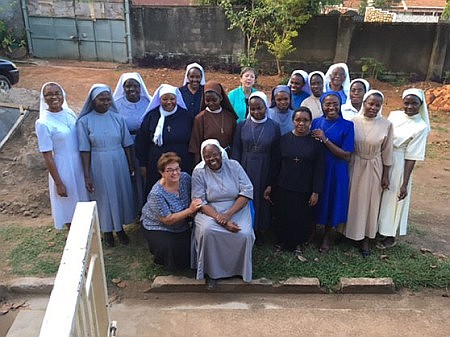
By Lois Rogers, Correspondent
As president of Georgian Court University, Mercy Sister Rosemary Jeffries devoted a lion’s share of her time to opening doors in ways that expanded the educational and cultural horizons of the students there.
Under her watch – from 2001to 2015 – the school transformed, gaining university status, going co-ed and embarking on a multi-million-dollar expansion that brought new residence halls, a state-of-the-art library and nationally recognized wellness center to the institution on the banks of Lakewood’s Lake Carasaljo.
There was a growing emphasis on to many opening doors to the universal Church as Georgian Court sought an increasingly diverse student body, faculty and staff. Their varied insights and shared experiences broadened campus life as did mission trips and projects in national and international mission fields.
Now, nearly two years after she retired as president of Georgian Court, Sister Rosemary is opening doors to mission fields once again.
This time, it’s as executive director of the All Africa Conference: Sister to Sister.
The organization was initiated 15 years ago by women religious of North America who were looking to collaborate with religious sisters of Sub-Saharan Africa in ways that would benefit their front-line ministries in the AIDS/HIV pandemic, Sister Rosemary said.
The conference is dedicated to the empowerment of African religious women through education, with a strong focus on faith formation, said Sister Rosemary, who has been at its helm since Sept. 8, 2016. She has already made trips to Africa, developing connections with many African religious women leaders there engaged in the ministry.
In a break from a busy schedule – which sees her traveling back and forth from the Jersey Shore to the AACSS office in the Bronx several times a week and stops at the small office in the Sisters of Mercy motherhouse in Watchung – she spoke enthusiastically of this new chapter in her life, of what the conference has already accomplished and how much more still needs to be done.
New Adventure
Sister Rosemary had reached the end of the sabbatical year she was granted upon retiring as president of GCU and was starting to look for a new course to chart, when she decided to explore the conference. “The more I learned, the more it seemed like a good fit.”
“We are always talking about the global Church,” she said. “At Georgian Court, we were always seeking ways to get involved on that level. I realized that this would enable me to do that in a deliberate way.”
The support she received from her fellow Mercy Sisters was a big factor in the decision, she said. “At a meeting with the sisters, many of whom are retired or semi-retired, the room was packed, and there was a lot of interest. The sisters were very engaged and peppering me with questions; it was heartening.”
She said she was inspired by their willingness to support the ministry to help educate religious women in other parts of the world.”
Their response reminded me of how privileged we have been because of the Mercy community’s emphasis on education, she said”
Over the years, the conference has sponsored workshops designed to help the African sisters learn more about how they could help with the ongoing health crisis with workshops on AIDS/HIV in six sub-Saharan countries – Uganda, Malawi, Nigeria, Cameroon, Zambia and Zimbabwe – which have engaged some 3,000 sisters, she pointed out.
A partnership with two Catholic universities in Uganda – the University of Kisubi and Uganda University – along with the Association of Religious in Africa has developed degree programs with high quality coursework inclusive of Catholic values, she said.
To date, more than 120 sisters have achieved degrees in counseling – including seven with master’s degrees and five-month human development seminars to nearly 100 sisters, according to an article she recently wrote, which appeared in the Association of Catholic Colleges and Universities.
Of a recent trip to Uganda, Sister Rosemary wrote that she was moved to hear first-hand from the sisters how beneficial these experiences have been.
Equipped with their new knowledge, the sisters are “transforming attitudes in their communities toward the underlying causes of HIV and AIDS,” and in doing so, filling a critical need in countries where nearly 70 percent of the global population now living with HIV and 91 percent of new infections worldwide among children can be found, according to statistics provided by AACSS-USA.
Sister Rosemary was particularly upbeat about a new program, “Transformative Education and Faith,” which weaves faith formation and Catholic teaching indelibly into the mix.
Carefully created by African theologians, social sciences and researchers, with the assistance of religious women academics from the United States, the curriculum, in partnership with the Uganda Martyrs University, leads to a credit-bearing diploma, she wrote.
Those who are able to pursue this two-year residential program, which costs $15,000 all-inclusive for the two years – will be “equipped with a deeper understanding of the Catholic faith, knowledge of biblical studies and spirituality, and increased insights into the challenges of poverty, gender discrimination and injustice toward the common good,” she said.
Global Awareness
As she begins seeking “ways to help support the ministry,” Sister Rosemary said she finds herself “entering into a good conversation about religious life in the United States where vocations are diminishing, and the developing world, where they are flourishing.”’
Sisters here and in Africa are “on fire,” she said of the goal that’s “making people’s lives better. Better for families, better for the global Church.”
Some of the sisters she met are preparing for master’s degrees in pastoral faith formation in order to use their skills in their own communities.
“One sister has started a counseling center. Some are becoming counselors in girls’ high schools. Many are interested in adolescent counseling,” said Sister Rosemary, noting that the sisters take with them the strength borne of personal knowledge of what it is like to lose one or both parents to AIDS. In addition, many have experienced violence and civil unrest.
“They need someone to walk with them,” she said, to let them know, “that they are loved by God,” she said.
“When religious women get together, they tell stories of how blessed they were to be very well prepared by the sisters who were our guides. These new young religious deserve a good foundation,” she said, adding that they deserve to be able to tell the same kind of stories.