
By Paul Senz | Catholic News Service
There is perhaps no better exemplar for the Christian life than the Holy Family of Jesus, Mary and Joseph. While each is celebrated, commemorated and honored in unique ways throughout the church year, the Sunday following Christmas is generally observed as a feast in honor of the whole family.
As with all saints the church has raised to the altars, the Holy Family is to be revered and emulated. As we celebrate it in a special way on this feast, we would do well to reflect on specific lessons that can be learned from the Holy Family today.
It may indeed be that, when considering the Holy Family, we tend to emphasize the fact of its holiness and neglect its other constituent feature: that it truly was a family. As a family, they would have lived together, eaten together, played together and prayed together.
During his general audience on Dec. 28, 2011, Pope Benedict XVI reflected on the Holy Family, particularly the role played by St. Joseph: “As we know, the Gospel has not recorded any of Joseph’s words: His is a silent and faithful, patient and hardworking presence.”
What a beautiful example Joseph sets! Tasked with providing for and protecting the Blessed Mother and the Son of God, he silently and persistently works to be the man he is called to be.
“We may imagine that he too, like his wife and in close harmony with her, lived the years of Jesus’ childhood and adolescence savoring, as it were, his presence in their family,” Pope Benedict continued. Here, St. Joseph shows us the importance of always remembering the presence of Jesus in our lives, in our families — real, true presence, at the heart of it all.
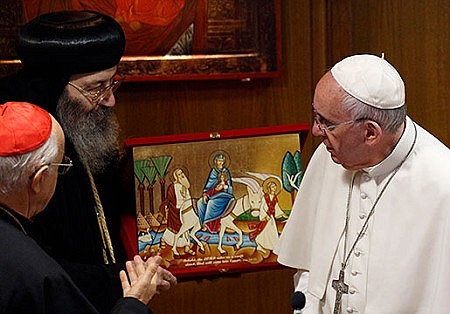
Under the headship of Joseph, the Holy Family persisted through many hardships, a few of which have been recounted to us by the Gospels. One of the most dramatic examples comes to us in the Gospel of Matthew, when the Holy Family is forced to flee their homeland as refugees, escaping the tyranny of King Herod. Yet through all of these struggles, their faith never wavered.
St. Joseph certainly would have taught Jesus to pray, together with Mary. Pope Benedict noted, “Joseph, in accordance with the Jewish tradition, would have led the prayers at home both every day — in the morning, in the evening, at meals — and on the principal religious feasts.”
Again, the Holy Family shows us the importance of prayer as part of the essential rhythm of everyday life.
St. Joseph is patron saint of, among many other things, a happy death. It is not difficult to see why this is: Tradition holds that St. Joseph died with Jesus and Mary at his side.
We hear a great deal about Joseph in the Nativity and infancy narratives in the Gospels, particularly in the Gospel of Matthew. However, it is interesting that we do not hear anything directly about Joseph in the Gospels following the incident when Jesus went missing and was found teaching in the Temple at age 12.
This has contributed to the tradition that, by the time Jesus was grown and in active ministry, Joseph was already dead. And it also contributed to the idea that Joseph had died in the company of Jesus and Mary.
Certainly, we can all hope to die in the company of Jesus and Mary. One thing we can learn from the Holy Family, and St. Joseph’s death in particular, is to trust that we will not be abandoned in our final hour.
This is one of the chief responsibilities we have to our families: steadfastness — as God does not abandon his people, as Mary did not abandon her son, as Jesus did not abandon Joseph.
In his homily on the Feast of the Holy Family in 2015, Pope Francis said, “How important it is for our families to journey together toward a single goal! We know that we have a road to travel together; a road along which we encounter difficulties but also enjoy moments of joy and consolation.”
The Holy Father said that at the end of the Holy Family’s pilgrimage to Jerusalem, “Jesus returned to Nazareth and was obedient to his parents. This image also contains a beautiful teaching about our families. A pilgrimage does not end when we arrive at our destination, but when we return home and resume our everyday lives, putting into practice the spiritual fruits of our experience.”
Here Pope Francis is once again emphasizing the fact that family life is more than simply a biological coincidence. It is a reality that informs our whole lives.
One of the most important lessons we can learn from the Holy Family is that God has given us the gift of the family to help us on our earthly way. It takes no stretch of the imagination to see that we live in challenging times — or to see that Jesus, Mary and Joseph did, as well.
But their unity, a reflection of the Trinitarian unity that all families personify, surely provided strength and fortitude by the grace of God. We are called to do the same.
Senz is a freelance writer living in Oregon with his family.
The Holy Family knew the struggles of ordinary family life
By Kelly Bothum |Catholic News Service
The other day I joked that parenting was a bit like trying to fit one more school photo into the picture frame hanging on the wall. You open it up and find so many wonderful memories inside, then try to squeeze in one more and hope the whole thing doesn’t come crashing down.
Some days, when the laundry is manageable, the dishes are done and the house is reasonably clean, I feel like we are actually handling life with three kids, two working parents, a dog, a fish and a calendar that magically fills itself.
Of course, that’s about the time the toilet backs up, a school project suddenly becomes due and the dog decides to throw up on the carpet — again.
I’m going to be honest — on these days, it’s tough. Sometimes, I have a pity party. I whine to myself about how life isn’t fair. I complain to God. I magnify my struggles and harden my heart. This is not me at my most glamorous.
Thankfully, I don’t remain this way for very long. After all, my life is incredibly blessed and it’s silly to think otherwise. But it’s the quiet strength of the Holy Family that helps me find the plunger, grab the poster board and turn on the steam cleaner — in other words, to get back to the business of life.
Sometimes in the midst of it all I do cry out, “Jesus, Mary and Joseph,” but, really, they totally know where I’m coming from.
They are the Holy Family, but I don’t mean the mild-faced people with the sinless wife (literally), the perfect Son (literally) and the hardest-working dad (hey, he makes stuff with his hands).
They are, of course, all of those things. But they also were faced with an unexpected pregnancy, several last-minute moves, a complicated parenting relationship for Joseph, and, for Mary, the kind of pain no mother expects to endure.
And they made it through those trying moments. Every time. Without question. How? By living a life of faithful obedience.
Mary accepted her role as the mother of the world’s Savior even though she didn’t understand God’s reasons. Joseph listened when the angel appeared and told him to protect his young family by taking them to Nazareth. Jesus accepted his Father’s will to save us all.
On the surface, Jesus, Mary and Joseph may seem like the perfect family because, well, they are. But there’s a risk of glimpsing the Holy Family only through the lens of perfection. We miss ourselves in the reflection — or at least our attempt to live a life worthy of God.
The members of the Holy Family are our models not just because they get it right, but because they know what it’s like to struggle. They know worry. (I joke that even Mary and Joseph once lost their kid in a busy place.)
They give us hope on days when everything seems hopeless or when our beliefs seem to run counter to everything we see on television and social media. They remind us that it’s OK if we don’t have all the answers — we don’t need them when we rely on our faith in Christ.
The truth is, our families are the most basic part of our church. It is in the home where we first learn of God’s love for us and the ultimate sacrifice made for us by his Son. As parents, we teach our children how to pray, how to thank God and how to be of service to others. It’s where we become us.
It’s also where we first see the grace of God — in a sibling’s forgiveness, in a mother’s comfort to her child, in a father’s protection even in uncertain times. Our children learn from watching us. And we, in turn, have much to learn from the Holy Family.
Did Mary have to clean up dog vomit after a bad day? I’m not sure. But I do know that her unflagging faith in the face of much worse gives me something to cling to when I’m feeling low. Unlike the picture frame on the wall, there’s always a place for us with the Holy Family.
Bothum is a freelance writer and a mother of three.
Recognizing holy families
By Daniel Mulhall | Catholic News Service
Although church tradition is rich in stories about the Holy Family, including stories of the Blessed Mother Mary’s childhood with her parents Joachim and Anne, there are only a few accounts in the Gospels that mention the family life of Jesus, Joseph and Mary. What we do have appears in Chapters 1 and 2 of the Gospel accounts of Matthew and Luke.
Here we find the familiar stories of Jesus’ birth, the visit of the Magi, the flight into Egypt to escape the murderous King Herod and Jesus getting left behind in the Temple when he was 12 years old. Nowhere do these stories describe the life of the Holy Family other than the brief passage in Luke 2:51 that says that Jesus was obedient to his parents.
But while the Gospel accounts are not explicit, one can easily see there the values Mary and Joseph lived by and passed along to Jesus. This was certainly a home filled with the love for and devotion to God. Both Mary and Joseph were devout — they prayed and went to Jerusalem to worship — and they taught Jesus to do the same.
Mary and Joseph were certain to know the stories of their faith and families and passed them on to Jesus. Remember that Jesus at 12 years old sat among his elders with confidence and engaged in learned debate.
He had been raised well to know and live his faith as part of a proud family, and Scripture says that Jesus “advanced in wisdom and age and favor before God and man” (Lk 2:52).
One can imagine Jesus listening to Joseph and Mary as they read and discussed the Torah. Similarly, one can imagine Jesus learning to care for the sick, feed the hungry, clothe the naked — all part of the Jewish tradition — from watching his parents and relatives do the same.
Jesus was brave in proclaiming the good news of God’s kingdom, even if doing so cost him his life. Certainly he learned this from the courageous Mary — who accepted God’s call to be the Mother of God — and the brave Joseph, who took as a wife a pregnant woman carrying a child not biologically his own, and did everything in his power to protect and nurture them.
Pope Francis, in his apostolic exhortation “The Joy of Love,” notes that in the family we find “a home filled with the presence of God, common prayer and every blessing,” and a “place where children are brought up in the faith” (No. 15-16). He says that families play the critical role of passing on to children the important stories of God’s love and mercy for us.
In the family “one learns endurance and the joy of work, fraternal love, generous — even repeated — forgiveness, and above all divine worship in prayer” (No. 86). The family, the pope writes, is “a vital cell for transforming the world” (No. 324).
The Holy Family serves as the ideal example for all families as to how to do this.
Mulhall is a catechist who lives in Louisville, Kentucky.
FOOD FOR THOUGHT
The World Meeting of Families is a week-long international gathering of prayer, catechesis and celebration that has occurred every three years since 1994. The next meeting will occur in August 2018 in Dublin with the theme “The Gospel of the Family: Joy for the World.”
The last World Meeting of Families in September 2015 drew to Philadelphia hundreds of thousands of people eager to partake in the days’ keynote addresses and breakout sessions and to see Pope Francis, who attended for the last two days.
“God always knocks on the doors of our hearts,” the pope said during impromptu remarks at a prayer vigil at the Festival of Families. “But do you know what he likes best of all? To knock on the doors of families,” he continued.
“To see families who are united, families who love, families who bring up their children, educating them and helping them to grow, families who build a society of goodness, truth and beauty.”
“Certainly in the family there are difficulties,” the pope acknowledged. But he offered a last bit of advice, “Never end the day without making peace in the family.”