
By Catholic News Service
IN A NUTSHELL
The rite of ordination bestows on the new bishop, priest or deacon a special gift of the Holy Spirit, which enables him to exercise a sacred power for the service, upbuilding and communion of the church.
A priest knows that he is not alone in his ministry. It is not his ministry to begin with. It is the ministry of Jesus that he entrusted to the church.
There is a relationship between ordained priesthood and the universal priesthood of the baptized. The priesthood is not for the priest alone but for the entire community.
The sacrament of holy orders: At the service of communion
By Father Derek Anderson, SOLT | Catholic News Service
Over the course of 2,000 years, the church has canonized myriad bishops, priests and deacons. Certainly each of these men lived an exemplary life of holiness, but what is common to all of them is their path to holiness was marked by a unique sacrament: holy orders.
The term “order” (“ordo” in Latin) refers to a group or a body into which a man is incorporated through the rite of “ordination” (“ordinatio”).
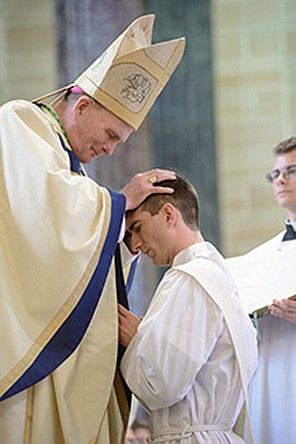
Through the reception of the church’s rite of ordination, a man is consecrated, or set apart, by the laying on of hands and prayer of consecration, and is incorporated into the order of bishops, priests or deacons into which he is ordained.
The rite of ordination bestows on the new bishop, priest or deacon a special gift of the Holy Spirit, which enables him to exercise a “sacred power” for the service, upbuilding and communion of the church.
The sacrament of holy orders is the concrete way “through which the mission entrusted by Christ to his apostles continues to be exercised in the church until the end of time” for the salvation of all (Catechism of the Catholic Church, No. 1536).
Although the sacrament of holy orders is constituted as one sacrament, there are three different “degrees” in the sacrament: the episcopate (bishops), the presbyterate (priests) and the diaconate (deacons). All are at the service of communion in the church, but each in its own unique way.
Bishops hold the chief place in the exercise of service to the church. For this reason, bishops receive the fullness of the sacrament as they take the place of Christ as teacher, shepherd and priest, and represent him “in an eminent and visible manner” (No. 1558).
Bishops are united with one another under the pope, and in that communion they form a “college” with personal responsibility for both their individual dioceses, as well as for the entire universal church.
Priests are, to a subordinate degree, co-workers with the bishops. Through ordination they are configured to the person of Christ and are consecrated to preach the Gospel, to represent Jesus to the church and to lead those entrusted to their pastoral care in divine worship. In the celebration of Mass, priests exercise this ministry to a supreme degree.
Deacons constitute the last degree in the sacrament of holy orders. Although not a priestly degree, deacons are consecrated to serve, and they hold a special role in the assistance of the bishop and priests at Mass. Deacons are configured to Jesus “who came not to be served, but to serve” (Mt 20:28).
In a society with tendencies toward radical individualism, many question whether we need the church in general, and a church hierarchy in particular; is the church absolutely necessary for salvation?
Hopefully as Catholics we understand the answer is an unequivocal “yes” to all the above. For others, however, that answer is not as clear, and they have legitimate questions on the topic. The journey toward “yes” often requires an honest, conscientious consideration of key philosophical notions such as “freedom” and “authority.”
Much has been written already on that last point, but beyond the search for one’s philosophical presuppositions and the subsequent need for their purification, it is beneficial to ask oneself another question not considered frequently enough: What does God want?
We can find an initial answer to this last question by turning to the Catechism of the Catholic Church.
The catechism offers a pithy historical overview of the sacrament of holy orders in Scripture and the living prayers of the church. Scripture reveals that the Israelite people were established by God as “a kingdom of priests, a holy nation” (Ex 19:6), and that God chose and set apart the tribe of Levi, one of the 12 tribes of Israel, for divine worship and liturgical service (No. 1539).
The church sees a prefiguration of the ordained ministry of bishops, priests and deacons of the New Covenant already in the Old Covenant priesthood of Aaron, the institution of the 70 elders and the liturgical service of Levites responsible for proclaiming the word of God and offering sacrifices and prayer (No. 1540-41).
While the sacrifices of the Old Testament did not have the power to restore communion between God and humankind, everything the priesthood of the Old Testament foreshadowed does ultimately find its fulfillment in the priesthood of Jesus Christ, “the one mediator between God and men” (1 Tm 2:5), when he offered the perfect sacrifice of himself on the cross for the salvation of the world (No. 1544).
It is precisely so that this one, perfect, eternal and saving sacrifice would be made available to all people throughout history that Jesus constituted his apostles as priests of the new covenant and gave them authority to celebrate the eucharistic sacrifice. Jesus established the hierarchical nature of his church so that he could always be present to his bride, the church.
Jesus’ words at the Last Supper to his apostles to “do this in memory of me” reveal his plan to bring about true communion with God and others in the Eucharist and supremely fulfill his promise that “I am with you always, even until the end of the age” (Mt 28:20).
Father Anderson is a priest for the Society of Our Lady of the Most Holy Trinity. He holds a licentiate of sacred theology in dogmatic theology and has served as director of the office of catechesis of the Diocese of Paterson, New Jersey. He is pastor of St. Mary’s Parish in Dover. Find him on Twitter @soltpadre.
The priesthood: A ministry not my own
By Father Kevin Dyer, SJ | Catholic News Service
The most meaningful day of my priestly career began with a call from a former student. Her grandmother had been lying in bed at the final stage of her life while the family waited for the end to arrive.
After two weeks of waiting, her aunts began to wonder why their mother was holding on to life with such tenacity. My former student guessed that her grandmother, a believing Catholic, was waiting for a priest’s visit before beginning her passage into eternity.
Arriving at the house, I was led into the grandmother’s room. By this time, she was incapable of talking or responding. I informed the people in the room that the dying often know what is happening even past the time they can communicate, so they should speak what needed to be said.
I then offered some of the prayers of the church, including the final commendation. The ceremony is simple yet profound. Once it was over, I spoke some parting words and showed myself to the door.
On the way out, my former student remarked that while we were praying, her grandmother’s hands, once icy cold, had become burning hot. She knew what was happening.
I returned to my car knowing that I had to hurry back home. I had a baptism scheduled for that afternoon. It was the first child of a couple who had met as Fellowship of Catholic University Students missionaries and were now beginning their family.
I’ve come to find that it is difficult to mess up a baptism. You have a baby, happy relatives, water and the Trinitarian formula. If a priest messes that up, it’s his own fault.
It helped knowing that for this particular family, this Christening was not simply a generic rite of passage, but a dying and rising with Christ that began in this world and reached out into the next. The baby girl was baptized Cecilia and entered into the life of grace.
Upon departing from the chapel, I glanced at my phone and noticed a voicemail I had missed while setting up for the baptism. It was from my former student. She had called to inform me that within a half-hour of my departure from their house, her grandmother had passed away surrounded by her family.
It was the kind of ending one only expects in a book, but honestly, I was not surprised. This is the way God works.
A priest’s life is surrounded by life and death, both biological and spiritual:
— The lives of all people, young and old.
— The new life of the baptized and forgiven, or the new life of the married couple.
— The sting of death, somewhat blunted in those who have led a full life, but throbbing with raw force in the death of a young child.
— The spiritual death of sin from which the priest is constantly calling all people — including himself — with the words that God gives him.
There are days when a priest’s life seems a swarm of activity, where he struggles to keep track of the disparate events, projects, problems and opportunities that come his way.
As a young man, the priest worries that he is not up to the task. As a somewhat older man, he knows that this is so.
The stakes often seem enormously high, but such is the result of living in a world where things matter. I, for one, would not want to live in any other world.
But I know that I am not alone in this ministry. It is not my ministry to begin with. It is the ministry of Jesus that he entrusted to the church.
On that day that began with a peaceful death and ended with a joyful birth, I experienced that ministry alive and active whereby Jesus continues to make himself present to the people who have eyes to see him.
Jesuit Father Dyer is the chaplain of Jesuit High School in New Orleans.
‘Amazed, grateful and in awe’
By Father Herb Weber | Catholic News Service
Even after more than 40 years as a priest I find myself amazed and surprised in the ministry. The amazement comes from the types of ministry into which I have been called. The surprise is the way I view priesthood both in itself and in its relationship with the laity of the parishes where I have ministered.
I always felt called to parish ministry. Since ordination, however, I have discovered the rich mosaic of that ministry.
Looking back, I am amazed that I had the privilege of working in a university campus parish with young adults and faculty, in providing ministry in both Spanish and English, in making weekly visits to share faith with the men on death row at the prison near the parish, and most recently becoming the planter and founder of a new Catholic church community.
Of course, I have also found significant joy in daily opportunities for working with the dying, for baptizing and marrying, and for teaching both children and adults. There is an ongoing sense of richness in my life that overwhelms me. No wonder I am grateful.
The surprise is not less wonderful. That is how I have come to understand the relationship between ordained priesthood and the universal priesthood of the baptized. As I have learned to appreciate the baptismal priestly call, I have actually found new clarity in my understanding of ordained priesthood.
Before I was called to priesthood, I was called to be fully committed to following Jesus. This grew out of the baptism that took place three days after I was born. I wasn’t able to use those words then or in my early childhood, but I look back and can see that being a “practicing” Catholic really meant that I was learning to accept the responsibilities that come with faith.
As an ordained man, I lead the faith community in specific ways. Often I become aware that my priesthood is not for me alone but for the entire community.
I celebrate Mass or the sacrament of reconciliation with others as my unique role in the community. Yet this ministry grows out of the universal call and I become responsible for others’ well-being even more than my own.
If we start defining the priesthood as what ordination allows us to do that other baptized persons cannot do, then we are missing the connection. We fail to discover that all sacraments take place within the context of the church.
Just as this faith community needs me, so I need the faith community as sisters and brothers who inspire me and allow me to be who I am.
The surprise, therefore, has been that my understanding of what it means to be ordained has not diminished as I minister side by side with those not ordained. We are on this faith journey together.
Sharing in the universal priesthood is what has allowed me to be part of the community in which I can also serve in a way that constantly holds me in awe.
Father Weber is the founding pastor of St. John XXIII Parish in Perrysburg, Ohio.
FOOD FOR THOUGHT
Is access to the priesthood sold, Pope Francis asked during a general audience in St. Peter’s Square March 26, 2014, where he discussed the sacrament of holy orders.
“No,” the pope said, “this is an initiative that the Lord takes.” The Lord calls whom he wills, Pope Francis emphasized.
All three grades, or degrees, of the sacrament of holy orders — bishop, priest and deacon — the pope said must “shepherd the Lord’s flock with love.”
He described three aspects of the sacrament. First, the ordained are placed “at the head of community,” but, he stressed, that “means placing ones’ authority at the service” of the community.
A second characteristic of the sacrament is “a passionate love for the church,” Pope Francis said. “Through holy orders the minister dedicates himself entirely to his community and loves it with all his heart: It is his family,” he said.
Finally, Pope Francis said, the minister must “always rekindle the gift that is within him” through prayer, listening to the word of God, celebrating Mass daily and frequent confession. Otherwise, bishops and priests will “in the long run lose their union with Jesus and become so mediocre that they do not benefit the church,” the pope said.
Addressing the young men in the crowd, he said, “If some of you have heard this call (to the priesthood) in your heart, it is Jesus who has placed it there. Pay attention … and pray that it might grow and bear fruit for the whole church.”