
By Dorothy K. LaMantia | Correspondent
While many college students soaked up the sun on tropical beaches or slalomed down ski slopes during spring break, 35 students from Massachusetts, Ohio and Florida found themselves enriched by a road trip to Trenton, where they lived and worked with the urban poor.
Accompanied by supervisors, the young adults participated in the FaithJustice Xperience, a week of service sponsored by the Center for FaithJustice, Lawrenceville. The program immerses the younger generation in service opportunities in inner cities and rural areas to teach them about the realities of poverty while raising their awareness of Catholic social teaching and whetting their hunger for justice.
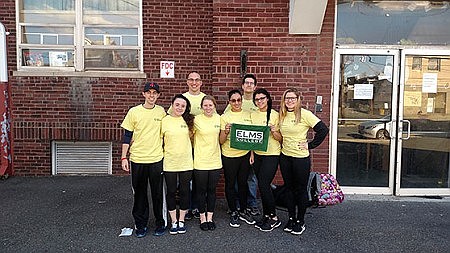
From March 6 to 11, students from two Catholic colleges in Massachusetts – Assumption College, Worcester, and Elms College, Chicopee – participated, followed by students from the University of Central Florida, Orlando, and Ohio State University, Columbus, one week later.
“These students voluntarily gave up their spring break to take part in work service projects at nonprofit organizations,” said Tara Hank, executive associate for the Center for FaithJustice.
From 9 a.m. to 3 p.m. each day, students worked at the School of the Arts, also known as Sprout University, which offers child care and early education services; Trenton Area Soup Kitchen; UIH Family Partners, a program to support men in their role as fathers; Visitation Home, Hamilton, a Catholic residence for adults with developmental disabilities, and Carolyn Stokes Preschool, Ewing.
Serving food, sorting through clothing and spending time with residents made it possible for the students “to see a face, learn a name and hear a story … to meet their neighbor and see God in them,” a direction Elms College students took from Eileen Kirk, assistant director of campus ministry.
“I thought I saw poverty in my hometown, but Trenton opened my eyes,” said Andrew Belliveau, sophomore special-education major in Elms College.
“The people are trying to make it the best they can,” he said. “They were grateful for what they have in a way that better-off people aren’t. It was impactful when I brought a tray of food to a man who said, ‘I’m so grateful for you bringing me this food. I am just happy someone smiled at me today.’”
Belliveau said he came away from the experience with a new attitude. “When I am in Boston, I see the homeless, but I guess I didn’t treat them with the respect they rightfully deserve. Because I have gotten to know the people of Trenton, I will now do what I can to make their lives better.”
Kaitlin Bowen, a sophomore speech therapy major in Elms College, agreed. “Hearing the stories of the homeless showed us whom we were serving. It was eye-opening, how hard they work to make it. When I did meals for the poor in Boston, it was easy to look away, but now I’ll try to smile instead of looking away. It’s small, but even a smile can change them.”
Melissa Taylor, a junior biology major in Assumption College, noted, “At the food bank, people weren’t just going for food. Volunteers helped people working on their GEDs to get better jobs and better lives.”
Students gained insight on working with the poor by observing the staff at work, too.
“The moment we stepped in the door, we could see the love the staff had for those kids,” Taylor said of Sprout University, a charter school. “We could tell the director was so proud of the work they were doing.”
Carlo Castillo, a senior majoring in chemistry in Ohio State University, noted, “At UIH, a staff member had a lot of wisdom and said if a problem is overwhelming, it’s important to remember there’s something you can contribute, even if it’s small.”
Joined by FaithJustice’s partners, students participated in an evening of communal prayer at Soup and Psalms, a weekly service at FaithJustice’s retreat house CASA, the “Convent at St. Ann,” where the students prepared the meal. The retreat house is located on the grounds of St. Ann Parish, Lawrenceville.
Evenings were spent reflecting upon the day’s events and also learning about the role of advocacy to counter systemic poverty.
A online video game – www.playspent.org – showed the realities of living on fixed incomes, another eye-opener for Bowen, who said, “I hadn’t seen poverty on a large scale in the U.S., but it is a big problem. The whole experience made me more focused on ways in which I can help. I cannot wipe out poverty and hunger, but I am encouraged to do something little to make a change.”
The week also inspired the students to encourage their peers to join them for whatever service project comes next – and shed new light on their futures.
“It provided me with a new perspective as to the greater good that my degree can be applied to,” mused Castillo. “Service trips have shaped my world view and my faith. Serving the less fortunate is an important and tangible way to live the Gospel.”
For more information on the Center for FaithJustice and its programs, visit www.faithjustice.org.