
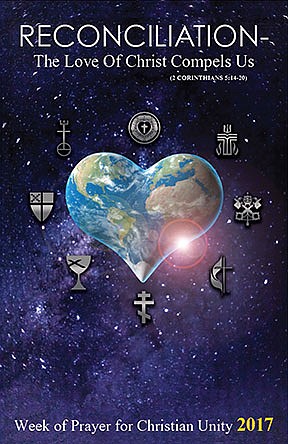
With over a 100-year history, the octave of Christians praying together for unity in faith returns this month, moving toward the fulfillment of Jesus’ prayer at the Last Supper, “that they all may be one.” (cf.John 17:21)
The year the Week of Prayer for Christian Unity falls on Jan. 18-25, with the theme “Reconciliation – The Love of Christ Compels Us.” (cf. 2 Cor 5:14-20).
Various ecumenical groups were asked, in preparation for the WPCU, to prepare a basic text on a biblical theme. Following edits by the World Council of Churches and the Pontifical Council for Promoting Christian Unity, the final material was sent to member churches and Roman Catholic dioceses, to translate and contextualize the text for their individual uses.
“It was in the context of the Reformation Anniversary that the Council of Churches in Germany took up the work of creating the resources for WPCU 2017,” read a statement from the Graymoor Ecumenical and Interreligious Institute. The theme was born, the GEII stated, out of a two-fold recognition of two focuses: the celebration of God’s love and grace, and ‘justification of humanity through grace alone,’ reflecting the concern of churches following Martin Luther’s Reformation; and the pain of the subsequent deep divisions afflicting the Church – openly naming the guilt and offering an opportunity to reconcile.
The United States Conference of Catholic Bishops have made available on their website several suggestions and links to resources for celebrating WPCU. Ideas include thematic poster art, music and prayer cards in both English and Spanish; Scripture readings, commentaries and questions for reflection; an ecumenical prayer service model; and historical and contextual information.
The GEII website gives a detailed history of WPCU, beginning with the first observance in January 1908. Beginning 50 miles outside New York, two American Episcopalians – Father Paul James Wattson and Sister Lurana White, co-founders of the Franciscan Friars and Sisters of the Atonement, wanted to see the reunion of the Anglican Communion and the Roman Catholic Church. They began a prayer movement which ultimately grew to a worldwide observance.
When Father Wattson and Sister Lurana became Roman Catholics, the website attests, Pope Pius X gave his blessing to the Church Unity Octave – and in 1916, Pope Benedict XV extended its observance to the universal church. This recognition by papal authority gave the Octave its impetus throughout the Roman Catholic Church.
For more information and ideas for observing WPCU, visit www.USCCB.org, www.GEII.org, or the World Council of Churches, Oikoumene.org/en/resources/week-of-prayer