
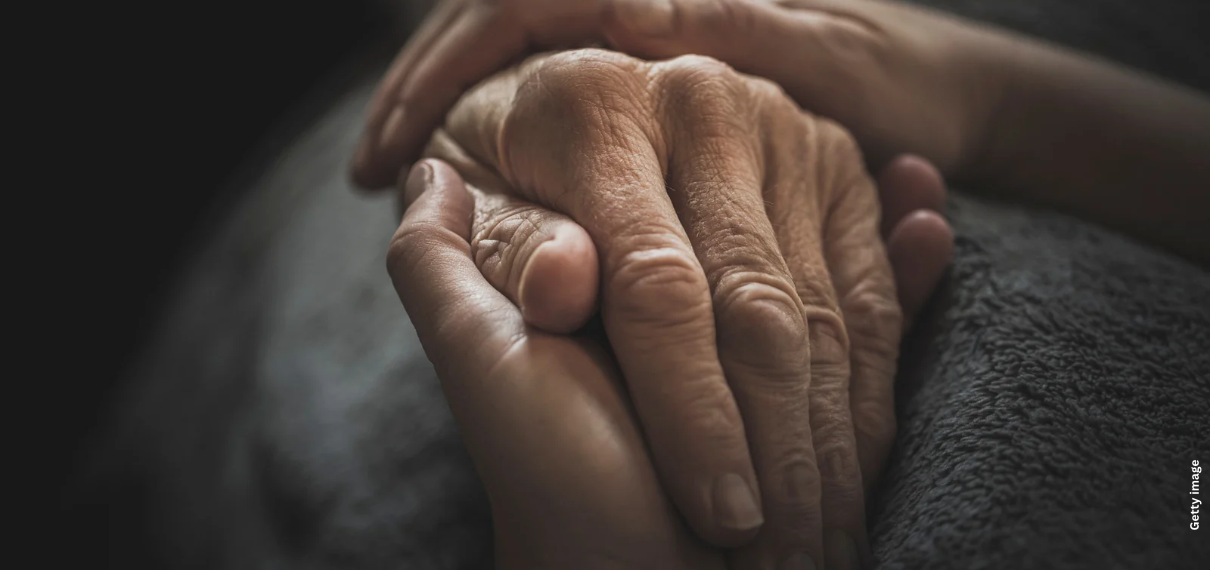
Top photo caption: Getty image
By Greg Erlandson, OSV News
Our last parent died this past month. The last grandparent slipped away in the quiet of the night. My mother-in-law, Andrée, finally put aside her joys and her burdens and left us all.
Andrée was the last surviving parent for my wife and me. She was our children’s last surviving grandparent. She was a quietly remarkable woman. Born in what was then French Algeria, married in Casablanca, she left family and friends to follow her husband, Joseph, to America.
Here Andrée managed her husband’s construction business while raising four children. She befriended other immigrant women, then outlived them all. She was a natural cook and a generous hostess. She and her husband lived modestly, putting all four children through college.
Later in life, they found their dream home in the Pacific Palisades. It was a simple ranch house with three bedrooms and enough land for a small fruit orchard and a garden. Her husband grew fava beans and tomatoes. She grew the herbs with which she cooked.
When Joseph died nine years ago, Andrée carried on, but gradually she became quieter. As the need for caregiving became more obvious, she moved to a beautiful Catholic assisted living home called Nazareth House. She stopped asking about her home. She never knew that it was devoured in the Pacific Palisades fire of 2025 that consumed the neighborhood she loved.
The fire also consumed Andrée’s local Catholic church, Corpus Christi. It was the church where my wife and I were married, but the modern brick and steel church was burned to the ground. It was up to her children to find another church for her funeral.
Funerals are declining in popularity. Families are spread out. Children are busy. Perhaps they have no personal connection to the faith of their fathers and mothers. A priest once told me that when the first spouse dies, a Catholic funeral usually follows. But when the remaining spouse dies, there may be no one to insist that a funeral is in order. Obituaries these days underscore the point: Someone’s active involvement in their parish and their community may be chronicled, but ends with the note: No funeral or memorial service scheduled.
In Andrée’s case, she had told my wife that she wanted a Catholic funeral. And the parish she had attended before the family’s move to the Palisades filled the breach: St. Mark’s in Venice, California. Family and friends gathered from as far away as Europe, but most striking was the fact that all of her grandchildren from across the country were there as well.
Funerals are an opportunity for evangelization and welcome. They can also reorder one’s priorities. It is so easy these days to sleepwalk through life, distracted by worries and diversions, carried by the current of passing concerns. A funeral is a moment to put all that aside. It allows us to contemplate our own mortality and the mortality of those we love more than anything in the world.
The Scripture readings, the music, the solemnity of the moment can console us in our grief. Most important is the priest celebrant who becomes the face of the welcoming church. In Andrée’s case, Father Albert van der Woerd was that welcoming presence – inviting, consoling, blessing.
And as the perfect punctuation point to the funeral, a side altar was covered with photos of those parishioners who had died in the past year. It was an ofrenda, an altar prepared for All Souls Day, El Dia de los Muertos, bedecked with marigolds and under the steady gaze of our Lady. It was a reminder that we were not alone in our loss and not alone in our hope, our hope in the Lord.
Greg Erlandson is an award-winning Catholic publisher, editor and journalist whose column appears monthly at OSV News. Follow him on X @GregErlandson.
Catholic journalism is needed now more than ever. Please consider supporting this work by signing up for a SUBSCRIPTION (click HERE) or making a DONATION to The Monitor (click HERE). Thank you for your contribution.